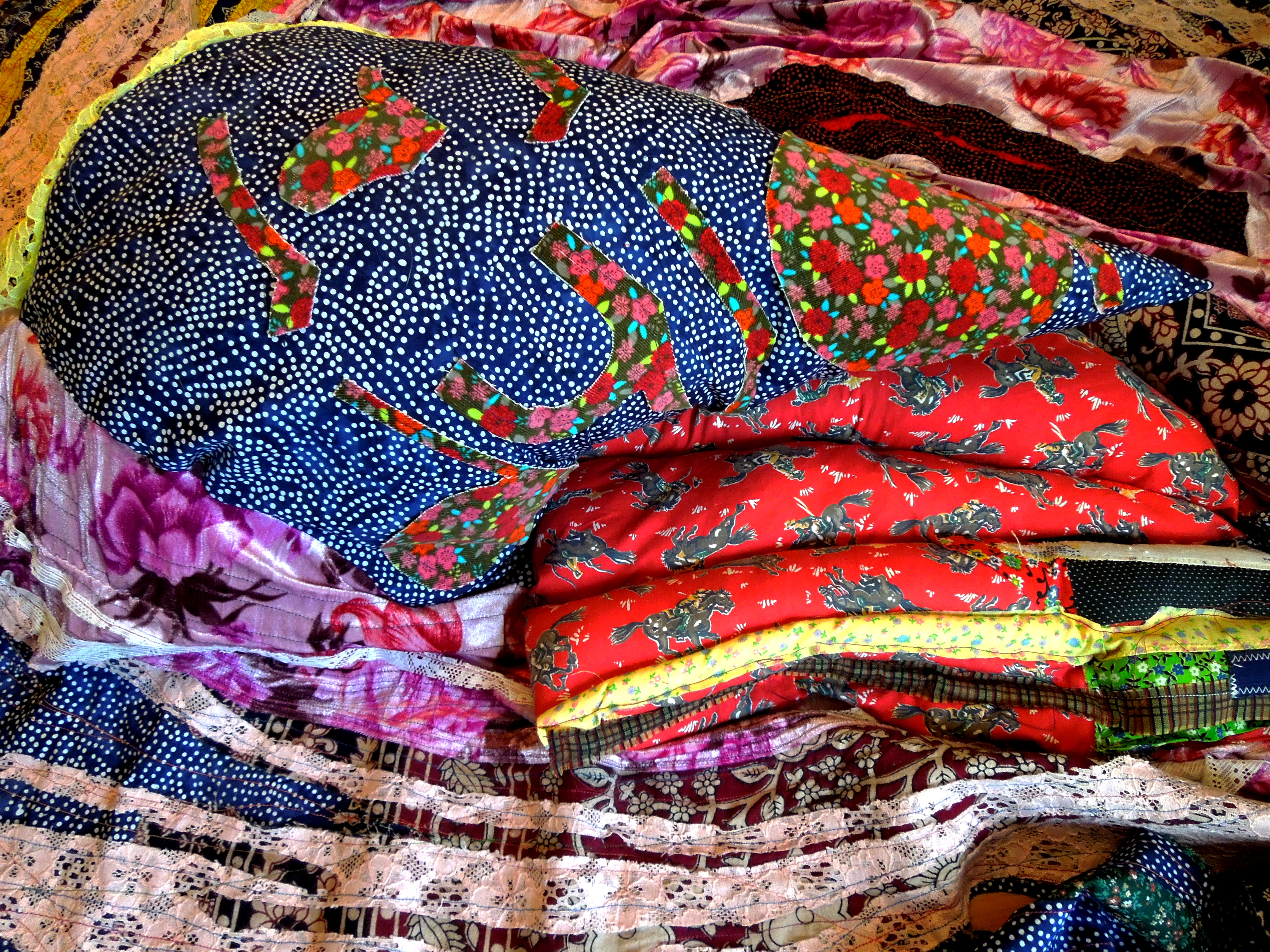
Unfinished Sewing, Mrs. Helen Jeu began when I inherited unfinished sewing and craft projects from my aunt’s mother. Helen Jeu left behind over 70 years of quilting, embroidery, and knitting. She lived in Altheimer, Arkansas, a small town in Jefferson County, but came to this country from China.
Helen started labeling her various sewing projects when she was diagnosed with Alzheimer’s disease. She seemed to be leaving herself (or her family, perhaps) reminders for what she intended to make with particular pieces of fabric. Some of the notes are very cryptic:
Sew both side shoulder together
How would one wear that garment? Some of the notes are very beautiful:
All clean, press
No hole
Good for vest
I was inspired by a package I found that Helen’s sister Violet sent her. It had knitting patterns and materials. I started putting materials and instructions together into kits. I made sewing kits from Helen’s supplies for the “From My Home to Yours” participants. I tried to construct the kits in the same way that I make drawings.
Here’s a link to my old friend Keeley Murray’s craft blog. She received one of the “From My Home to Yours” kits that had Helen Jeu materials in it. So did my friend Kristi Rae Wilson, a jewelry artist in Houston, who has made some wonderful work from quilt scraps. Her work is often inspired by history and family relationships.
I really like the idea of finishing these projects incorrectly. It doesn’t really matter because new work will come from it.
This little lamb will be included in Animalier: The Animal in Contemporary Art, an exhibition sponsored by the Studio Art Program at Northwestern Oklahoma State University.
“Believer” will be one of 32 works from 25 artists in 9 countries and 7 U.S. states represented in the show. Curator Brandice Guerra, Assistant Professor of Art and Director of Studio Art at the university received 127 works from 69 artists in 12 countries and 19 U.S. states. I’m pleased as punch.
I started drawing with an electric drill in graduate school. It was the one tool I brought with me from home and was a gift from my dad. I like to demo this for my students when we talk about line quality and sensitivity to changing our line by what we do with our bodies. I just thought I would post some pictures of my students practicing. I’m working on a large drill drawing in between the Rose Bowl pieces, which are small.
About five years ago, I bought a catalog for the 1946 Tournament of the Roses at a flea market. I loved the quality of the blocky color printing and the strangeness of the floats. They had themes like “Victory in Flowers” and featured doves of peace breaking rose-covered swastikas. The faces of the crowds are in somber shades of gray, the spot color was saved for the floats. It all struck me as very funerary. I am in love with the faces of the War Queens, selected in the years of the Tournament’s slumber, smiling in victory as they claim their titles. The Queen and Her Court are posed on a terraced float covered in maroon and white roses. They could be enthroned in the midst of a cemetery. A mysterious man lurks to the right of them. A woman and her daughter are holding hands nearby. It is the same feeling as in the pictures of the parade; there is a disconnect between the participants and the audience. I think that impulse to cover our wounds with roses is very important and deeply American. These are the ideas I’m exploring in this current set of drawings.
This technique was taught to me by Mariah Johnson. Mariah is a painter and the director of Porch Projects in Washington, DC.
The technique is a great bridge between painting, drawing, and printmaking. Both Mariah and I like the look of prints, but we need to make images in a direct way. I also love the fact that each print is unique and special. It’s a less technical way of producing a printed image.
MAKING A SILKSCREEN MONOTYPE
Silkscreen: A print made from a stencil stabilized by a fabric mesh screen.
Monotype: A one-off print made from a hand-painted or hand-drawn stencil.
Making a Stencil
Lightly sketch your design in pencil on the inside of the screen.
1. Using a stiff brush, paint screen filler onto screen in areas that are to remain white.
Screen filler: A thick paint-like fluid that blocks out parts of the screen; made by Speedball.
2. Let the screen filler dry completely.
3. Draw directly onto the backside of your screen, the side of the screen that is flush to the wooden frame, with some type of water-soluble media. This is the design we will transfer to the paper.
Water-soluble media: pigment that will dissolve or loosen in water. Neocolor crayons, made by Caran d’Ache, are richly pigmented and water-soluble. I also used water-soluble graphite for this demonstration. Gouache, or opaque watercolor paint, although water-soluble, does not work with this technique.
Making a Print
1. Register, or line-up, your paper with the design on the screen. Mark the position of the paper on the table if necessary.
2. Use a squeegee to coat the entire screen with the water-soluble transparent base. This is the flood coat. Let it sit for a few minutes so that the drawing is rewetted.
3. Pull a print: Grip the wooden handle of the squeegee with both hands. Hold it slightly angled in toward your body. Press down with firm, even pressure and pull it down the inside of the screen from top to bottom. It takes some practice to pull with the right amount of pressure and speed.
4. Lift the screen, peeling the paper slowly away from it.
5. See what happened! Every monotype print is unique.
6. Hang the print up to dry.
7. Pull as many ghost prints as you can. You can continue to draw or print on these ghost images. To continue printing, shore up and register your paper properly.
The Test Run:
I adjusted a couple of things after printing 6 prints from the “Fresh Feesh” design. One, I removed the tape and opted for screen filler, as I direct you in the instructions. The transparent base wets and releases the tape’s adhesive. No good. So, I traced the outline of my drawing from tracing paper to the screen painted around it with screen filler. This will keep the paper clean. I made my new design 10 inches total. This way, it is about two inches narrower than my squeegee. I have soft tissue injuries to my wrists which kept me from really bearing down hard enough to prevent low spots of the upper corners. A narrower design made it much easier to pull the print. I also added some foam core under the paper to help it make contact with the screen.
The pics below show me preparing the screen for the demo. The drawing is of my mom as the 1946 Queen of the Tournament of the Roses. I’m obsessed with a bad off-set printed catalog from the 1946 Rose Bowl.
In celebration of Flag Day, I decided to create a flag for The Year of Living Collaboratively Campus. I used a remnant of one of my Islands that I had already stitched down to medium weight canvas. I knew I wanted it to be like the flags that I see outside my neighbor’s homes. They usually change them out with each season or holiday, but I wanted this flag serve as a welcome mat for the front of the house. I also wanted it to make Karin and Jimi and, hopefully, future residents laugh.
What I will say about trying to sew a joke is that you spend so much more time with it than when you are just letting stuff fall out of your mouth. About one hour in, doubt crept in. I kept sewing, hoping that I might finish before my hosts fell asleep.
The finished product is in honor of The Year of Living Collaboratively’s resident cat Kisu. It serves as a gentle reminder.
I have wanted to finish this collage for the past four years for my dear friend Masako Onodera, a brilliant glass, metals, and fibers artist in Bowling Green, Ohio. She gave me a beautiful wall sculpture made of gently curved small copper plates that had been joined at the corners with handmade ring closures and dipped in soft pink latex. So, she asked for this collage when it just had a bit of ink splats and embroidery in exchange for one of her glass and wool sculptures. At one point in my indecision on how to finish it for her, I started stitching these flannel cat faces to it. I wrote to Masako the next week, “I’m sorry it is taking me so long to finish your piece. I think I’ve made a terrible mistake.” But I love the cat faces now. Sometimes things take a long time to finish. I never gave up on this piece, although I did forget about it. So did Masako! She was surprised and delighted to hear that it was finally ready.
I really wanted to use part of my time at The Year of Living Collaboratively to finish some of the collaborative mail art and pieces I intended to exchange with other artists that I had just been nursing and sitting on for years. These things were not coming home with me.
Here are some pictures of the collage I finished Monday night. It’s packaged up and ready to go. I can’t wait for Masako to see it! It’s a lot of fun and I had almost forgotten that art could be that for me.
Today was our big boat trip out to Smith Island. Karin scoped out this cruise when we were planning my time here with the Year of Living Collaboratively.
I’ve been scouting options for some of our days during your residency. It looks like there’s a nice cruise to an island in the Chesapeake that would work really well for us. It would give us plenty of time to get documentation and also be a really nice day on the water.
!!!!!
-k
Here are some photos from our day. We were trying to make it look like a J Crew catalog.
My friend Kristi Rae Wilson had asked me to grow moss on a tiny plaster frame that I had silver-leafed and sent to her in a mail-art package. She had etched a floral pattern from the back of the card that accompanied the package into a copper plate and cut it down to fit inside the oval frame. She included a recipe for moss paint which was inspired by the June 2009 issue of Martha Stewart Living article “Pots with a Patina.”
Here is the recipe she gave me:
1 cup plain yogurt (buttermilk would also work)
1 cup water
1 handful of moss
Blend it up and paint it on anything you want to be mossy.
I finally mixed up some moss paint to patina the frame and several pots Karin had by the back stairs. I made a stencil that reads, “Yes” – my reply to Kristi’s simple handmade paper card asking,”Can you grow moss on this?” Them, I painted the frame and pots. I made sure everything was resting in a cool, moist, shady spot in the basement where a little light comes in through the window above the wash basin.
After we composted, I discovered some dry and dead moss that I harvested to try and make a less muddy batch of moss paint. I’ll have to compare which one grows better, the live of the dead moss.
Our first gardening project for Living Martha Stewart Living was to turn the compost pile that Karin and Jimi use to collect their organic kitchen waste. We decided that rather than follow Martha’s specific gardening tasks on her calendar, we would address a need that Karin and Jimi had in their garden. Everyone’s yard and gardens are microclimates and ecosystems with individual requirements. Martha’s plans to harvest greens from cold-frame beds, for example, would pull our time, money, resources. and energy away from a very important task in the micro residency. So, we settled on turning our attention to the compost pile.
Karin has been either actively or indirectly composting her entire life having grown up on a farm and the granddaughter of a farmer. I was excited to help her because I had never had a compost pile, but had learned much more about it recently when a neighbor helped my husband and I build a raised bed for vegetables.
Our basic mission was to remove most of the organic matter that was already breaking down to a bigger area in the back part of the yard to free up space in the pile that is convenient to the back door. This way, it’s as easy as stepping out the back door off the kitchen to throw compostable scraps into the pile, but it doesn’t get overly full.
Karin and I began after she had freshly mowed the lawn, giving her fresh green grass clippings to get the new pile started. But, first, we had to clear out the pit. We grabbed a shovel, a rake, gloves, a cultivator, and a plastic recycling bin. Karin showed me how to rake up all the dry leaves and twigs that had collected on top of and near the pile and throw those into the bin. We then shoveled the drier organic matter off the top and scraped down about five or six inches into the already decomposed soil. All of this went into the bin. We said hello to the worms, ants, and slugs that we met along the way, all good signs of decomposition and nutrition. We began to get nervous that the bin would be too heavy for us to move, but with one of us on each side, we hauled the bin to the back part of the yard where a larger pile of compost was chilling. This is in a shady and moist part of their yard. We raked some old grass clippings into a neater pile and dumped the organic matter from the bin on the other side of a patch of yard about two feet across and two feet wide. “Now, we make a lasagna,” Karin said, “Grass then dirt, then grass.” We raked a thin layer of the grass out. Karin pointed out some white mold that was forming on the grass, a good sign that it was doing what it should. We sprinkled a few shovelfuls of dirt over this and repeated until the two piles had been incorporated into one. Remember those fresh grass clippings? Karin dumped those from the mower bag right next to the lasagna we had just made. Those green clippings will be ready the next time she clears out the pile nearer to the kitchen. The last step was to water both piles down with a good soak from the garden hose. She set the watering head to Shower fora good even soak.
To clean up, Karin swept all the debris from her back stairs and patio into the freshly cleaned out pit along with a nice bed of the fresh grass clippings. She incorporated the clippings lightly with a cultivator.